

Why Floor Transitions Cause AGV Instability in Smart Factories
As smart factories continue to evolve, AGVs (Automated Guided Vehicles) and AMRs (Autonomous Mobile Robots) have become essential tools for modern manufacturing and logistics automation. They improve efficiency, reduce labor dependency, and enable continuous material flow across production lines and warehouses.
However, many factories discover that even with advanced navigation systems and intelligent software, AGVs can still experience unexpected instability during operation.
One of the most overlooked causes is surprisingly simple:
floor transitions and uneven surfaces.
Small floor gaps, expansion joints, ramps, metal plates, elevator thresholds, or worn flooring can significantly affect AGV movement, positioning accuracy, and operational stability.
In this article, Hickwall explores why floor transitions create instability in AGV systems and how modern caster design is evolving to solve these real-world factory challenges.
Smart Factories Are Not Perfectly Flat
In theory, AGVs operate best on perfectly flat floors. In reality, most factories are far from ideal.
Even in advanced smart factories, AGVs commonly encounter:
- Floor expansion joints
- Elevator thresholds
- Docking area gaps
- Steel plate transitions
- Slight floor height differences
- Epoxy floor wear
• Maintenance covers and cable trenches
These surface inconsistencies may appear minor to humans, but for AGV systems operating continuously and carrying heavy payloads, they can become serious operational issues.
As AGV adoption increases across:
- Semiconductor fabs
- Electronics manufacturing plants
- Automated warehouses
- Automotive production lines
the need for stable floor adaptation becomes more critical than ever.
How Floor Transitions Affect AGV Stability
1. Sudden Vibration and Payload Shock
When an AGV passes over a floor gap or uneven transition, the wheels absorb a sudden impact force.
This can cause:
- Payload vibration
- Sensor instability
- Mechanical stress
- Reduced transport precision
For sensitive products such as semiconductor wafers, electronic components, or precision instruments, even small vibrations may create operational risks.
2. Navigation Accuracy Deviation
Modern AGVs rely heavily on:
- LiDAR
- SLAM navigation
- Encoders
- Vision systems
When wheels temporarily lose stable ground contact during transitions, the AGV may experience:
- Encoder inaccuracies
- Position drift
- Path deviation
- Reduced navigation consistency
This becomes increasingly problematic in high-precision manufacturing environments where positioning accuracy is critical.
3. Loss of Wheel Traction
Traditional caster systems may struggle when crossing uneven surfaces, especially under heavy loads.
During floor transitions:
- Drive wheels may briefly lose traction
- Wheel slipping can occur
- Turning stability may decrease
This affects overall AGV movement smoothness and can reduce operational reliability.
4. Increased Wear and Maintenance Costs
Repeated impact from uneven flooring accelerates wear on:
- Wheels
- Bearings
- Suspension structures
- Drive systems
Over time, this leads to:
- Higher maintenance frequency
- Reduced wheel lifespan
- Increased downtime
For factories operating AGVs 24/7, these hidden maintenance costs can become substantial.
Why Conventional Casters Are No Longer Enough
Traditional industrial casters were originally designed for relatively simple transport tasks.
However, modern AGV systems demand far more:
- Continuous operation
- High-speed transport
- Heavy payload movement
- Precision navigation
- Complex factory environments
As a result, caster systems are evolving from simple mobility components into critical parts of AGV performance engineering.
This is where advanced mobility solutions such as AGV Step Casters are becoming increasingly important.
How Step Casters Improve AGV Floor Adaptability
AGV Step Casters are designed specifically to improve mobility across uneven floor conditions.
Instead of rigidly transmitting impact forces into the AGV structure, step caster systems help absorb and adapt to floor transitions more smoothly.
This provides several operational advantages:
Improved Surface Adaptation
The caster structure helps maintain stable wheel contact even when passing over small floor gaps or height differences.
Reduced Shock Transmission
Impact force is minimized before reaching the AGV chassis or payload.
Enhanced Navigation Stability
More stable wheel contact improves encoder consistency and movement accuracy.
Better Long-Term Reliability
Reducing repeated impact stress helps extend the lifespan of wheels and AGV components.
Why This Matters More in Heavy-Duty AGVs
As AGV payload capacity increases, floor transition problems become even more severe.
Heavier loads create:
- Greater impact force Stronger vibration transfer
- Higher wheel stress
- Increased instability during movement
This is why many modern heavy-duty AGV systems are shifting toward advanced caster structures designed specifically for real factory environments.
In smart factories, mobility stability is no longer optional—it directly affects:
- Operational uptime
- Automation efficiency
- Equipment protection
- Maintenance costs
The Future of AGV Mobility in Smart Factories
The next generation of smart factories will require AGV systems to operate not only intelligently, but also adaptively.
Future AGV mobility solutions must handle:
- Uneven factory floors
- Dynamic logistics environments
- Mixed-use facilities
- Long continuous operation cycles
This means mobility systems will continue evolving beyond basic wheel design toward:
- Shock-absorbing structures
- Adaptive caster systems
- Precision floor-following mechanisms
- Advanced wheel materials
The focus is shifting from simply “moving” to achieving:
- Stable movement
- Predictable navigation
- Reduced vibration
- Long-term operational reliability
Hickwall's Perspective on AGV Mobility Solutions
At Hickwall, we understand that real factory environments are never perfectly smooth. Modern AGV systems must operate across floor joints, ramps, expansion gaps, and uneven industrial surfaces while still maintaining stable movement and accurate navigation.
That is why AGV mobility solutions today must focus not only on load capacity, but also on:
- Floor adaptability
- Vibration reduction
- Navigation stability
- Long-term durability
- Smooth transition performance
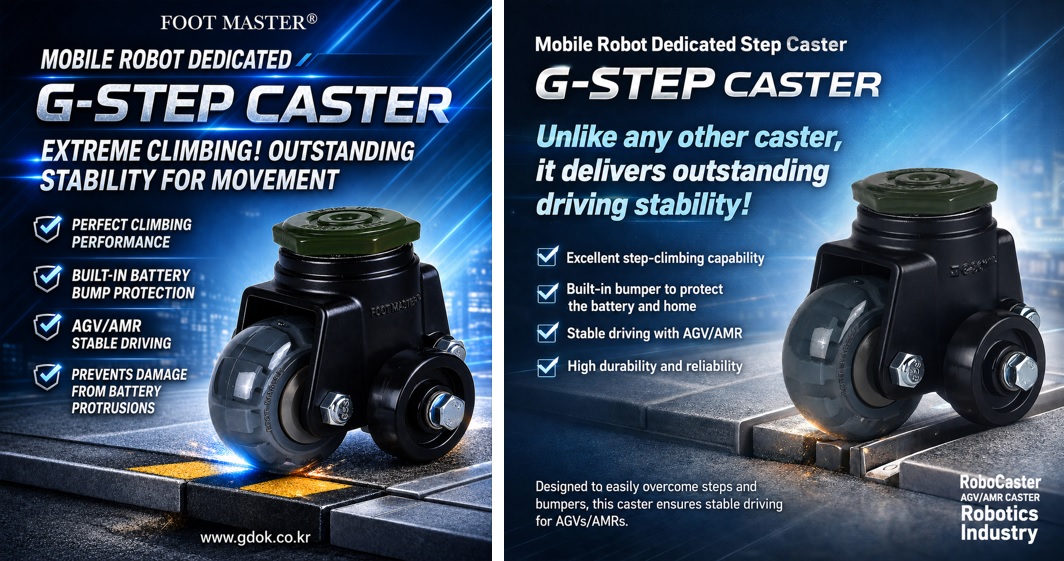
To address these real-world challenges, Hickwall provides advanced AGV mobility solutions such as the FOOT MASTER® G-STEP Series AGV Step Caster. Designed specifically for automated material handling environments, the G-STEP series helps AGVs and AMRs move more smoothly across floor transitions and uneven surfaces, reducing vibration impact and improving operational stability.
As smart factories continue evolving, advanced caster technologies are becoming an increasingly important part of AGV system performance, helping manufacturers achieve more reliable, efficient, and stable automation operations.
FAQ
1. Why do floor transitions affect AGV stability?
Floor transitions create sudden impact and vibration, which can affect wheel traction, navigation accuracy, and payload stability.
2. What types of floor conditions commonly cause AGV problems?
Common issues include expansion joints, floor gaps, ramps, elevator thresholds, steel plate connections, and uneven epoxy flooring.
3. How do step casters help AGVs?
Step casters improve surface adaptability, reduce vibration transfer, and help maintain stable wheel contact across uneven floors.
4. Why is wheel stability important for AGV navigation?
Unstable wheel contact can cause encoder errors, position drift, and reduced navigation accuracy in automated systems.
5. Are step casters only useful for heavy-duty AGVs?
No. While especially beneficial for heavy-duty AGVs, they are also valuable in precision applications such as semiconductor, electronics, and cleanroom environments.
6. How can factories reduce AGV maintenance caused by uneven floors?
Using advanced caster systems with better shock absorption and floor adaptability can help reduce wheel wear, vibration damage, and maintenance frequency.
Conclusion
In smart factories, even small floor transitions can create major operational challenges for AGVs and AMRs.
From vibration and navigation errors to wheel wear and maintenance costs, uneven flooring directly impacts automation efficiency and system stability.
As industrial automation continues advancing, the future of AGV mobility will depend not only on software and sensors, but also on how effectively the mobility system adapts to real-world factory conditions.
Choosing the right caster solution is becoming a key part of building more reliable, efficient, and stable smart factory operations.
At Hickwall, we provide advanced AGV mobility solutions designed for modern automation environments, including the FOOT MASTER® G-STEP Series AGV Step Caster, developed to improve floor adaptability, reduce vibration impact, and enhance AGV operational stability.
Whether you are building a new smart factory system or upgrading existing AGV equipment, our team can help you find the right mobility solution for your application.
Contact Hickwall today to learn more about our AGV caster solutions and discover how advanced mobility technology can improve your automation performance.