
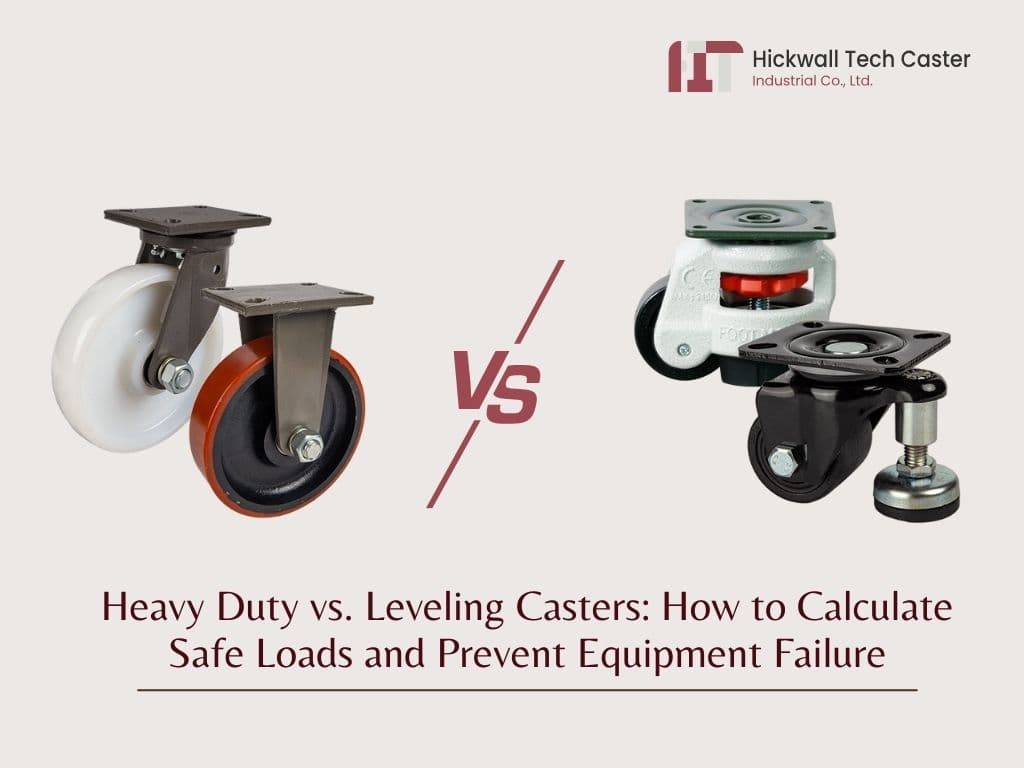
Heavy Duty vs. Leveling Casters: How to Calculate Safe Loads and Prevent Equipment Failure
In the hierarchy of industrial equipment design, casters are often treated as "C-parts" an afterthought left for the final stages of procurement. Yet, based on our 30 years of manufacturing experience at HICKWALL TECH CASTER INDUSTRIAL CO., LTD, approximately 15% of equipment downtime and floor maintenance costs stem directly from improper caster specification.
Whether you are designing a cleanroom for semiconductor manufacturing or planning an AGV logistics route for a heavy industry plant, the interface between your machine and the floor is a critical point of failure.
This engineering guide moves beyond basic product descriptions. We will analyze the two most critical categories of industrial mobility "Heavy Duty Casters & Leveling Casters" helping you make procurement decisions based on load mechanics, material science, and real-world scenarios.
1. The Engineering Basics: Calculating the "Real" Safe Load
A common mistake made by procurement managers is a simple division: Equipment Weight ÷ 4 Wheels. In a perfect laboratory environment, this works. On a real factory floor, it is a recipe for disaster.
The "Rule of 3"
Basic geometry dictates that three points define a plane. On uneven industrial floors, it is highly probable that your equipment will be supported by only three wheels at any given moment while moving over a crack or threshold. If your calculation assumes all four wheels are sharing the load equally, you risk overloading a single caster, leading to bracket deformation or bearing failure.
To ensure a sufficient safety margin, calculate the required load capacity per caster as follows:
HICKWALL Recommended Formula:
Choosing your Safety Factor (S):
-
S = 1.0 - 1.2: Smooth, indoor surfaces with low-speed movement (walking pace).
-
S = 1.5 - 2.0: Uneven floors, outdoor asphalt, or crossing thresholds.
-
S = 3.0+: Power towing (AGVs, forklifts). The initial torque and braking forces impose significant stress on the swivel head.
Pro Tip: Always calculate based on Dynamic Load (load while moving), not Static Load. Leveling casters often have a much higher Static Load rating once the foot is deployed, but they must still support the weight while being positioned.
2. Heavy Duty Casters: Built for Movement
When your application requires frequent relocation or the transport of loads exceeding 1.100 lbs (500 kg), you need Heavy Duty Casters. However, "Heavy Duty" is not just about thicker steel; it is about the right material for your specific floor conditions.
Wheel Material Selection: Balancing Durability and Floor Protection
The most common complaint we hear is, "The wheel is strong enough, but it ruined my epoxy floor." Here is how to choose:
| Material | Hardness | Key Characteristic | Best Application |
|---|---|---|---|
| Polyurethane (PU) | 90-95 Shore A | The Balanced Choice. Protects epoxy floors, resists oil, and operates quietly. | AGVs, Automated Warehouses, Electronic Assembly Lines. |
| Nylon (MC Nylon) | 70-80 Shore D | Lowest Rolling Resistance. Easy to push, highly resistant to chemicals, but noisier. | Machining centers with metal chips/swarf, Rough concrete. |
| Cast Iron / Steel | - | Indestructible. High heat resistance but offers zero vibration damping and will damage floors. | Foundries, High-temp ovens, Heavy manufacturing. |
The HICKWALL Advantage: Continuous Welding
Many generic casters fail at the fork base due to weak spot welds. HICKWALL heavy-duty series utilizes continuous welding technology on 6mm+ reinforced steel plates. Combined with double ball raceways (or thrust bearings in our ultra-heavy series), this ensures the swivel head does not seize up, even under maximum load.
3. Leveling Casters: Precision and Stability
For semiconductor equipment, optical instruments, or aluminum profile workstations, movement is temporary; positioning is permanent. This is where Leveling Casters are the only viable solution.
A leveling caster is a hybrid mechanism: a wheel for mobility and a built-in adjustable foot (pad) for stationary stability.
Ratchet vs. Thumbwheel: Which Mechanism Do You Need?
-
Manual Thumbwheel (Standard): Common on lighter equipment. You adjust the leveling pad by turning a dial by hand.
-
Drawback: Under heavy loads, the friction makes it difficult to turn the wheel without lifting the machine first.
-
-
Ratchet Mechanism (HICKWALL Recommended for Heavy Loads): Designed for heavy machinery. The integrated ratchet handle allows engineers to lift and level tons of equipment with minimal effort—similar to using a wrench. The handle is retractable, ensuring it doesn't interfere with the machine footprint.
Vibration Damping Control
Precision equipment hates vibration. Standard nylon wheels transmit floor vibrations directly to the frame. HICKWALL Leveling Casters feature high-grade NBR rubber pads. Once deployed, these pads act as shock absorbers, isolating the equipment from high-frequency vibrations in the factory floor, which is crucial for improving yield rates in sensitive manufacturing processes.
4. Environmental Factors: What the Datasheet Doesn't Say
Selecting the right load capacity is only half the battle. The environment dictates the lifespan of the caster.
-
Temperature Extremes: Standard PU wheels can delaminate or deform above 80°C. For baking ovens, opt for High-Temp Phenolic or Cast Iron. Conversely, in cold storage (-20°C), standard nylon becomes brittle; impact-modified nylon is required.
-
Chemical Exposure: If your facility uses harsh cleaning agents, acids, or solvents (e.g., plating plants), zinc-plated brackets will rust quickly. In these scenarios, 304 Stainless Steel brackets paired with Nylon wheels are the industry standard for longevity.
5. Frequently Asked Questions (FAQ)
Q1: Should I choose Top Plate or Stem mounting for heavy loads?
A: For any heavy-duty application, we strictly recommend Top Plate mounting. Four bolts distribute the stress across a wider area of the equipment frame. Stem mounts create a single stress point and are generally reserved for lighter carts or medical equipment.
Q2: How do I measure my existing leveling casters for replacement?
A: You need three key measurements:
-
Bolt Hole Pattern: The distance between the centers of the mounting holes.
-
Overall Height: From the floor to the top of the plate.
-
Wheel Diameter: Larger wheels roll easier over obstacles. Not sure? Take a photo and email it to our engineering team.
Q3: Does HICKWALL offer customization (ODM/OEM)?
A: Yes. Unlike trading companies, we are a manufacturer. We can modify wheel hardness, adjust mounting plate dimensions, or use specific grease for vacuum environments based on your project requirements.
6. Why Global Buyers Turn to "Made in Taiwan"
In the past decade, many international buyers have learned an expensive lesson: "cheap" casters often cost more in the long run. Production stoppages caused by wheel delamination or bracket failure far outweigh the initial savings of sourcing low-quality imports.
Since 1994, HICKWALL (HICKWALL TECH CASTER INDUSTRIAL CO., LTD) has maintained 100% production in Taiwan. Our promise is simple:
-
Virgin Materials: We never use recycled scrap for our wheel treads. This ensures 2-3x longer wear life.
-
Consistency: The caster you buy today will perform exactly the same as the one you buy next year.
-
Engineering Support: You speak with technical experts, not just sales reps.
Conclusion: Invest in a Solid Foundation
Casters are the legs of your operation. Whether you need the rugged mobility of a Heavy Duty Caster or the precise stability of a Leveling Caster, choosing the right spec prevents safety risks and protects your facility.
Looking for a custom solution? Don't guess on safety factors. [Contact HICKWALL Engineering Team Today] for a free consultation and quote. Let us help you calculate the perfect load rating for your specific application.